
The Richmond Heist
A tale of war, corruption, the lure of gold and murder most foul. If you're interested in that sort of thing.

I get my news the same way most Canadians do - water cooler gossip, social media, reading the headlines of paywalled Globe & Mail articles, and googling for context whenever a friend starts ranting in my groupchats.
I do not get my news by reading recently-released court decisions. The best evidence that nobody else does either arrived in August last year: a BC trial court declared that the Cowichan tribes had title to 800 acres of land in the Vancouver metro area, and nothing happened.
The fibre-optic outrage machine did not start machine-gunning society with hot takes.
The politicians didn’t grandstand.
The markets didn’t panic.
It was the city of Richmond - a subdivision of Greater Vancouver wedged between the arms of the Fraser River and the Pacific - that finally breached the dam of public apathy just before Halloween.
In painstakingly-worded municipalese, a letter to more than a hundred property owners along Richmond’s south shore informed them that they might not actually own their properties at all, and invited them to an information session at the Vancouver airport Sheraton to learn more.
At which point the shit hit the fan with remarkable velocity and volume.
The property owners enjoy “fee simple” title, traditionally an ironclad government certification that a piece of land exclusively belongs to you.
The property owners aren’t exactly sure what it means for them that the Cowichan now simultaneously hold “Aboriginal title” to the same land, because the court wasn’t asked to decide that question, but they can’t be feeling too cocky about the implications.
You see, the Cowichan did ask the court to settle the question of how their newly-declared Aboriginal title stacks up against the fee simple land titles held by the city of Richmond and the Port Authority in the same area, and the court found that those fee simple land titles are defective and invalid.
The trial court suspended its declaration of Aboriginal title for 18 months, to allow Canada and Richmond to reconcile the interests of the Cowichan and the broader public interest.
That reconciliation process has now reached the “emergency government loan guarantees” phase, which I understand from constitutional scholars is a good sign.
News that BC, a province blessed with both well-meaning citizens and Indigenous land claims to more than 100% of its territory, was once again struggling with the collision of those blessings was deeply unsurprising. I had my reaction to the headlines locked and loaded more or less instantly.
Then I read the court decision itself, and it left me not quite as sure what to think.
The legal technicalities don’t interest me much, since this case is inevitably going to the Supreme Court, where our top jurists are going to have their own opinions about the law.
But the facts found by the trial judge tell one hell of a story: war, kidnapping, murder most foul, and corruption at the highest levels of government.
Those who know the full story can reasonably disagree about what must be done. But I don’t think anyone who hears the full story will look at this case quite the same way afterward.
So let me tell you what happened.
***
Our tale begins in the dense chain of sharp-edged islands that run along Vancouver Island’s east coast from Victoria to Nanaimo, like a colossal reef, or the outworks of a giant’s fortress. From November through May, you would traditionally find the Cowichan nestled within.
Historical records suggest that you really didn’t want to find the Cowichan.
They maintained a standing army, including a strategically-situated garrison at Porlier Pass. The garrison controlled the northern approach to their territory, and was located within striking distance of the Fraser River delta on the mainland, just across the channel.
Other islands in the chain hosted observation posts, manned by sentries trained to recognize different types of canoes, paddles, and crests, all communicating with each other via megaphones made by drying and rolling giant kelp.
If hostiles were sighted, typically raiders from north coast tribes like the Haida, and if a counterattack could be assembled in time, the trespassers often had an ugly time of it: Cowichan national defence policy was to massacre invaders and mount their heads on sticks in the estuaries around their villages.
When incursions were too large for the Cowichan to repulse, they led alliances of other Coast Salish tribes into combat.
Take for example the Southern Kwakiutl - the southernmost of the northern tribes, and a common source of the punishing raids that had made life difficult for everyone in the area for years. The Coast Salish who lived closest to the Kwakiutl had even started speaking their language.
In the 1840s, around the same time that the Brits were founding the Colony of Vancouver Island, a war fleet of Southern Kwakiutl was lured into Maple Bay, in the Cowichan heartland just north of Fort Victoria.
They met a Cowichan-led army of Coast Salish and never made it home.
***
It must be said that the other Coast Salish probably didn’t join the Cowichan at the Battle of Maple Bay out of affection.
The Cowichan believed in a foreign policy of beating the dog snot out of whoever happened to look at them the wrong way, and that included the other Coast Salish.
When the explorer Simon Fraser first paddled down the river that would eventually bear his name, his guides directed him to the north arm, citing the risk of encountering the Cowichan on the south arm.
Twenty years later, when Hudson Bay Company fur traders attempted the south arm of the Fraser, one of their guides lost his nerve and stayed behind. He described the Cowichan as a barbarous and wicked people who couldn’t be trusted not to kill him, even if he encountered them while in European employ.
The HBC traders carried on down the south arm until they encountered a patch of flat land on the north bank, backed by a slope and surrounded by marshy ground, that they noted was “most eligible” for the construction of a fort.
Slightly downstream, they found a “terrible large” village nearly a mile long, perfectly positioned to control sightlines up and down the Fraser. Explorers described frame structures built with posts and beams so big that it wasn’t clear how the builders had manhandled them into place.
The Hudson Bay Company had stumbled across the Cowichan summer village.
They found somewhere else to build their fort - fifty kilometers back the way they came.
That “most eligible” stretch of river shoreline today, across from Tilbury Island, marks the south edge of Richmond. It no longer appears to have a name, unless you count the name of the industrial access road closest to the water.
The name the Cowichan gave it translates very roughly to “Long Beach”. Eventually, the Cowichan began to refer to not just the shoreline but to their summer village itself as Long Beach.
From November to May, you would find the Cowichan inside their Vancouver Island fortress. From June to October, you would find them at Long Beach, occupying pride of place at the heart of the West Coast’s greatest natural cornucopia: the Fraser River’s salmon runs.
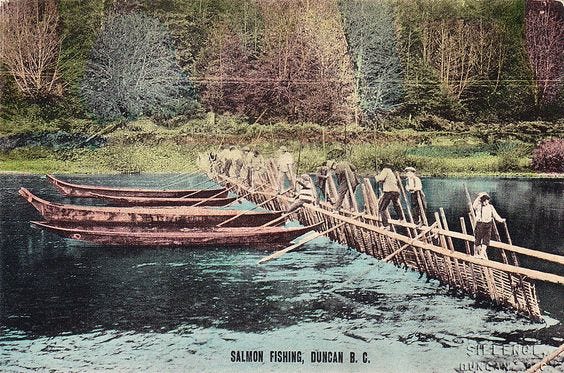
For six months of the year, it was a river of fish, literally, as four species of salmon (and a very confused trout) took turns making their way upstream to spawn, in numbers so dense you could almost walk on them.
Every year when the salmon started running, the great mass of the Cowichan people - warriors, wives, children, and slaves - stripped the painstakingly-manufactured cedar plank siding from their winter villages and relocated to Long Beach, where a skeletal forest of frames awaited installation of the siding to once again become multi-apartment housing organized into neighbourhoods.
The Cowichan travelled across the Georgia Strait cautiously, sticking together for protection, because the open water of the Strait was infested by the viking-like northern tribes.
Once they arrived at Long Beach, though, the boot was on the other foot.
During the half of the year when they lived at Long Beach, the Cowichan raided other Coast Salish tribes constantly, and seemed to relish unpredictable acts of intimidation that reinforced their status as the local heavyweights.
British fur traders observed that the “bloodthirsty” Cowichan “murdered and pillaged…at pleasure”, keeping the other Coast Salish around the lower Fraser in a state of such continual alarm and fear for their families’ safety that they barely managed to get any hunting done.
The Cowichan once rowed into a Musqueam village and killed their chief. No reason, Cowichan oral histories admit, just a random act of violence to dominate and deter.
On another occasion, a party of Cowichan happened across a Musqueam chief fishing on the riverbank with his family and kidnapped his eldest daughter on the spot. They told the chief that if he protested, they’d kill him and enslave the rest of his family.
The HBC clerk in Nanaimo reported to his superiors at Fort Victoria that a party of Cowichan dozens strong who had come through town to visit kin had shot a man on their way out of the harbour. No further explanation, no apparent justification.
You get the distinct sense that it was not good for your health to find yourself in the vicinity of the Cowichan.
***
Until now, the British have appeared in this story as explorers and traders. However, after negotiating a treaty fixing the American border at the 49th parallel all the way to the Pacific, the British began looking more favourably at the risk-reward calculus of establishing a West Coast colony.
The man the empire turned to was James Douglas, scion of the Scottish merchant elite and a free woman of mixed African ancestry whom his father had met in Guyana.
Since the age of 15, Douglas had worked as a fur trader in the territory that became Canada, educating himself via imported books. The forts he operated out of as he rose through the ranks of the Hudson Bay Company trace a line westward, from Thunder Bay across the Rockies, following the fur trade’s gradual advance of the Canadian frontier to the far coast.
When the British empire founded a colony on Vancouver Island, it was James Douglas, by then one of the highest-ranking men in Canada’s most powerful corporation, with a Métis wife and five living children, who took charge of HBC’s affairs on the island - and shortly thereafter, also assumed the colony’s governorship.
Living in Fort Victoria, only a short hop from Cowichan territory up-island, Douglas was painfully aware of the importance of good relations with the locals. It may surprise some readers to learn that London was, too.
The British Secretary of State wrote to Douglas:
The feelings of this country would be strongly opposed to the adoption of any arbitrary or oppressive measures towards [the Natives]…pay every regard to the interests of the Natives which an enlightened humanity can suggest.
Douglas wrote back:
As friends and allies the native races are capable of rendering the most valuable assistance to the Colony, while their enmity would entail on the settlers a greater amount of wretchedness and physical suffering, and more seriously retard the growth and material development of the Colony, than any other calamity to which, in the ordinary course of events, it would be exposed.
When Douglas wrote those words, he likely had a specific incident in mind from a few years earlier.
A Cowichan warrior of some repute had murdered a mild-mannered Hudson Bay Company shepherd at Christmas Hill, just north of Fort Victoria in what is now the leafy suburb of North Quadra.
For two months, demands that the Cowichan extradite the murderer were met with civilly evasive replies, but demands were all Douglas was capable of throwing at them.
Fort Victoria was, despite the name, near-totally defenseless. Its civilian population was in the low hundreds, and it had been denied funding for a garrison of British regulars. In their absence, Douglas leaned on his connections to assemble the Victoria Voltigeurs, a rural police unit consisting of about a dozen Métis scouts who had retired from their employment with HBC.
While the Voltigeurs were capable woodsmen, they were not an elite strike force. A Victoria bureaucrat once wrote in his journal:
This evening on passing Government house I was surprised to see Charbonna on [guard duty]…but he had no gun, probably not being able to arm them with anything better than trading guns…I can scarcely refrain at times from ridiculing openly such apery, and I don’t know if I do right in refraining from it.
By comparison, not counting their Coast Salish allies, the Cowichan mustered north of a thousand warriors. The Cowichan chief who usually took point in diplomatic talks with the British had made his reputation coordinating the Battle of Maple Bay, after which he’d been one of two warriors gifted a Kwakiutl wife as part of the peace deal.
Douglas was rescued from humiliation by the unexpected arrival of the British warship Thetis, which lent him a large complement of sailors and a couple dozen combat-trained Royal Marines.
When Douglas arrived in Cowichan Bay, near where the town of Duncan now stands, the Cowichan did their best to scare the living daylights out of the expeditionary force. Two hundred warriors chanted and whooped “like demons”. The murder suspect showed up with his friends and relatives, all armed to the teeth and bedecked in war paint. The marine officers had to repeatedly order their men to hold their fire.
A great deal of very tense negotiation followed, during which Douglas made the speech of his life.
He told the Cowichan that the Queen had given him a special charge to treat them with justice and humanity, and to protect them against all foreign nations who might attempt to do them harm.
He promised them that they could apply to him for redress for any injury or injustice they might receive at the hands of British colonists, and implored them not to retaliate to any such injury or injustice themselves.
In return, Douglas said that all he wanted was peaceful relations, and for the Cowichan to respect British arrest warrants.
Whether the Cowichan were persuaded by the promise of access to justice, British protection, resumed trade with Fort Victoria, or the presence of the scarlet-coated marine infantry is unclear. Douglas himself seems to have believed it was a little of all of those.
The Cowichan expressed regret over the death of the HBC employee and handed over the accused, who - still fully armed - went quietly.
***
Now let’s return to the scene a few years later: letters between Douglas and the British Secretary of State about ensuring the natives are well-treated.
They’re writing to each other because the island colony is about to expand its borders to encompass the entire mainland territory of modern British Columbia - as a defensive measure, ironically.
If you were travelling to the mainland territory of “New Caledonia” around this time, you probably weren’t a British settler, who were in preciously short supply. You were in fact almost certainly a California wildcat miner who’d heard tell of a gold strike on the Fraser River.
The population of Fort Victoria only amounted to a few hundred people in 1850. Eight years later, more than fifty thousand American miners had stampeded across the indefensible border at the 49th parallel in less than a year, squatting where they pleased, wrecking fishing grounds to sluice the rivers for gold, and by all accounts behaving like utter mutants.
Their sheer volume and energetic acquisitiveness threatened to unofficially turn the British empire’s mainland territory into an American outpost. Worse, Douglas worried, the miners might provoke a major war with the tribes - and if they won, might declare British Columbia annexed to the United States in a fit of exuberance.
Douglas must have nearly had a heart attack when the Fraser Canyon War broke out.
The miners had found the last nerve of an interior Salish tribe living on a mountain tributary upstream of the Fraser. Two miners were ambushed and killed, and when their compatriots organized into militias and set out to deliver retribution, the flag their formations flew was the Stars and Stripes - in British territory.
The war was fortunately small-scale and short-lived, but the British empire saw the writing on the wall: they needed to settle the mainland rapidement to counterbalance the “facts on the ground” being created by the miners.
***
Enter Colonel Richard Moody, a gentleman engineer much caressed by the royals for his artistic renovation of Edinburgh Castle. His father was a big wheel at the Colonial Office, and his wife descended from the union of an industrial dynasty and a merchant banking family. With the recent, dramatic growth of the colony’s footprint, the empire wanted to send its best.
Douglas and Moody loathed each other instantly.
Moody arrived in British Columbia at the head of a detachment of Royal Engineers, directed by the Crown to conduct surveys of BC’s territory and to construct roads and public works. The next year, Moody was also made responsible for auctioning off the newly-surveyed lands to settlers.
The original plan was to auction off only land that had already been surveyed, but funds were always in short supply and the Royal Engineers couldn’t keep up with demand - so Douglas changed the plan. No survey would be required prior to making a land claim.
In a procedure known as “pre-emption”, any settler who wished could show up, lay claim to a spot they liked, and begin developing it. They didn’t even have to pay until the Royal Engineers got around to surveying the settler’s new property.
Douglas noted in his directive that the new pre-emption procedure would require the boundaries of all land that the government would likely need in the future, as well as all Indigenous villages and cultivated fields, to be marked immediately, so that no settler mistakenly attempted to claim or develop land that would bring them into conflict with either the government or the tribes.
Douglas sent Moody a letter ordering him to mark those boundaries “as soon as may be practical”, instructing him in the case of Indigenous reserves to rely on the Indigenous people themselves to point out to the Royal Engineers the boundaries of their villages and fields.
Although he didn’t know it at the time, Douglas had unwittingly set off a tidal wave of corruption, and the ringleader appears to have been Richard Moody.
Douglas later wrote to Moody through a subordinate about “concerns” that had reached his ear.
Officials associated with Moody’s Land and Works Department were personally accumulating land at a spectacular rate - Moody himself had apparently acquired nearly 2,000 acres in eleven different locations.
The Land and Works Department was also apparently in the habit of informing newly-arrived settlers that the land they were interested in settling was reserved for government or Indigenous use, then withdrawing the reservation at a later date and allowing the land to be claimed by people connected to the Department.
While the court decision doesn’t record Douglas’s reaction to hearing this news, it appears - filtered through dry bureaucratic language - to have been apoplectic.
He ordered Moody to “forthwith” publish in three different places in each district and in all the local newspapers the position and extent of all reserved land. Moody was also ordered to immediately send Douglas a map of British Columbia showing all of the land that had been reserved to date, as well as all of the land already claimed by settlers (and apparently, by government officials with an eye for the main chance).
The same day, Douglas circulated a memo informing staffers that the purpose of the pre-emption policy “was not to give facilities to servants of the Government to speculate in land”, but to encourage “actual settlers” to move to BC and contribute to the development of the colony.
A week later, not having bothered to follow Douglas’s initial directive to do so months ago, Moody ordered an officer of the Royal Engineers to mark the boundaries of all Indigenous reserves. The officer wrote back with questions, and Moody provided terse answers to each, including this one:
Q: Many Indian families having Summer + Winter residences widely separated, in what way should the Lands be appropriated?
A: As they claim.
Despite that step, an exchange of correspondence between a Douglas subordinate and Moody a year later suggests that Moody had settled into a strategy of malicious compliance. He appears to have begun requiring surveys of all reserve claims, and actually wrote to Douglas complaining of the expense.
A Douglas subordinate wrote back, confused that Moody was surveying reserve boundaries when his instructions had been to merely mark them, and shocked that the process of marking those boundaries, which was of the “utmost importance”, hadn’t been completed yet.
A year after that, Douglas wrote directly to Moody, asking why he was getting so many complaints from the tribes about how small their reserves were. He wondered how that could possibly be, given that his instructions to Moody had been to mark the reserve boundaries where the village chiefs told him to.
In a fit of spectacular chutzpah, Moody told Douglas that his instructions to Moody had been insufficiently complete, causing misunderstandings that Moody’s department was unfairly catching the blame for, and that furthermore, there were language barriers between the department and the Indigenous chiefs.
Douglas’s reply to Moody arrived via a subordinate, presumably because upon receipt of Moody’s letter, Douglas had achieved a level of rage incompatible with effective communication but possibly compatible with aggravated assault.
The instructions you were given, the subordinate wrote to Moody, “cover the whole question”, and Douglas expected those instructions to be “carried out to the letter”.
Six months later, in November 1863, Moody and the Royal Engineers shipped out for England. Douglas never got his map of all the provincial reserves.
Shortly before departing, Moody made one final purchase. Using a land agent to conceal his involvement, he bought two sections on the Fraser River’s southern arm.
Surveys of those sections had already been completed four years previously by one Joseph Trutch, at Moody’s specific request. The surveyor noted an “Indian village” - the Cowichan summer village of Long Beach.
This proved no barrier to the purchase. Even though Moody knew of the village’s existence, and had likely known for years, it hadn’t been reserved by the Land and Works Department.
Moody never returned to Canada again.
***
The purchase of Long Beach caused no conflict with the Cowichan at first, because nobody bothered to tell them.
Since Moody was an absentee land speculator, there was also no indication to the Cowichan that anything had changed when they arrived every summer at Long Beach to fish. They remained blissfully unaware of its new legal status for another fourteen years.
In 1874, Joseph Trutch, now the Lieutenant Governor, formalized the Crown grant of Long Beach after Moody paid the final installment of the purchase price.
In 1878, word finally reached the Cowichan that Long Beach had been sold out from under them.
Douglas was dead by then, and with settlers now flooding into BC and a warship permanently stationed in Esquimalt, the balance of power had shifted considerably.
The Cowichan complained to the Joint Indian Reserve Commission, and Commissioner Gilbert Sproat noted in a letter to the Lieutenant Governor that the Cowichan complaint appeared to be valid. He asked what might be done about it.
It’s not clear if Sproat ever received a reply, but it’s also not clear that he was particularly motivated to follow up.
Three years previously, his business partner, a Justice of the Peace, had purchased land on the same waterfront. So had Thomas Lett Wood, the Solicitor General of British Columbia, and likewise Robert Burnaby, who had begun his career in BC as Moody’s private secretary, and had then been elected to the BC legislature before going into the real estate business.
***
The Cowichan continued to lodge protests with the imperial bureaucracy wherever they could. Petitions in subsequent years by the Cowichan to the Premier of British Columbia, the Prime Minister of Canada, and King Edward VII all vanished into the ether without a substantive response.
Meanwhile, the world kept turning.
In the 1870s, industrial salmon canneries began to sprout like mushrooms on the south arm of the Fraser, and the salmon’s numbers began to thin.
In 1885, it became illegal for Indigenous people to leave their reserves without a pass issued by an Indian Agent.
The Kuper Island Residential School opened in 1890, and in 1920 attendance by Cowichan children became mandatory. At least 121 children are confirmed to have died there, including two sisters who drowned during an escape attempt.
In 1894, Canada restricted the Indigenous from fishing for food without government permission.
The Cowichan migration to Long Beach grew smaller every year, and ceased entirely around 1915.
In 1927, Canada forbade Indigenous people from hiring lawyers, and from bringing land claims or raising money to do so.
Since Long Beach consisted primarily of peat bogs unsuitable for farming, it remained mostly undeveloped and poorly serviced by roads. During the 1920s and 1930s, tracts of land in Long Beach were forfeited one by one for non-payment of taxes, and the township of Richmond was deemed the new owner.
In the 1950s, Richmond began using Long Beach as a garbage dump.
In 1966, regulations increased the permissible length of ships transiting the Fraser River, and the government of Canada purchased several tracts of land on Long Beach for potential construction of a new deep-sea port. Sixty years later, it still hasn’t been built. Those portions of Long Beach are now partially used for container storage by the Port Authority.
In 2005, I left home in Alberta to study at the University of Victoria. I was indirectly introduced to the Cowichan by a dorm mate from up-island, who informed me that Duncan was a town full of drunk Indians and best avoided.
In 2013, the Cowichan declared a state of emergency due to high youth suicide rates.
Two centuries later, it turns out it’s still not considered good for your health to find yourself in the vicinity of the Cowichan.
***
I am hesitant to insist that the problem of the Cowichan summer village has a correct solution. I can summon no zeal to persuade you that we must follow a certain course.
On the one hand, we have been informed of gross misconduct by a government official, abetted by his colleagues. Solemn promises were made when they suited us and broken when they didn’t. Further, the delay in bringing this matter to light is our own fault: the consequence of a century of determined attempts to sweep this dirty moment in Canadian history under the rug, instead of either fixing what we’d done or embracing it.
On the other hand, the Cowichan aren’t saints, the villains in this story are long dead, sovereignty is an inherently selfish concept, and commercial certainty is a highly desirable principle. Righting historical injustice is important, but it’s not a pyre we must bind the national interest to.
There are likely many reasonable solutions, and the largest barrier to finding one is the all-too-common reaction that this situation is out of our control. We talk like we’re helpless bystanders, handcuffed by our courts - like we’re inventors of a giant robot that has broken free of its programming and is rampaging through downtown Vancouver.
It’s just not true. We are in complete control.
At the directive of the voters, our elected leaders have been passing legislation for decades now, constitutional and statutory, that amount to official policy on Indigenous issues in this country.
Our courts have responded exactly the way they’re supposed to. They’ve been taking the official policy of our legislatures as marching orders, and in the absence of any word from the legislature that they’re marching in the wrong direction, they’ve carried on with their delegated task of figuring out exactly what we owe Indigenous Canadians.
You’re allowed to believe that the answer is “nothing”. Heck, you can propose that we fly planes over reserves trailing banners reading “WE DECLARE YOU OFFICIALLY CONQUERED”.
But whatever you believe, however milquetoast or pragmatic or aggressive, you have to put your money where your mouth is. That is where our nation’s innumerable keyboard warriors and barroom philosophers typically stumble.
Specifically, you have to listen to a frank summary of the horrible crap the Canadian government did in the past that we now benefit from, look a judge right in the eye, and say “that’s compatible with my sense of honour”.
And a critical mass of Canadians, for decades now, can’t do it.
The Supreme Court of Canada determined in 2024 that the government deliberately drew the borders of an Alberta reserve 162 square miles smaller than what had been agreed to in the treaty, and then lied about it.
Our elected leaders had every chance to endorse that behaviour on our behalf. Instead, they admitted to the court that the government’s conduct had been “very serious”, “dishonourable”, and “unconscionable”.
We follow our moral compass as a nation, and the law follows in our wake. We decide what our sense of honour demands of us, and our collective instinct becomes the legal concept that the courts refer to as the honour of the Crown. We have been leading our courts to the decisions they make about what Canada’s honour demands.
We must now do the same in the matter of the Cowichan summer village.
After reading the trial court’s decision, I know only one thing with iron certainty. I do not wish to be associated with Richard Moody’s crimes. It is not a stain that I want on my honour.
How can that stain be removed? Policy is a complicated beast, but it certainly doesn’t seem impossible to handle this pragmatically. At the time of the trial court’s decision, the portions of Long Beach owned by Richmond that are most valuable to the Cowichan contain a pump station, one regional water main, sanitary sewers, and a sanitary pump station. Those most valuable portions are otherwise unused, undeveloped, and unoccupied.
Giving us a chance to thoughtfully reconcile our national sense of honour and our national self-interest is what the 18-month suspension of the court’s declaration was for.
It’s a pity that so much of that head start appears to have been thoroughly wasted.